
chortle on a chortle
an underestimated obstacle to infrastructure
It is silly season and summer reruns – I’m sorry for the non appearance of Friday’s post. However, I am not, I think, as lazy as whoever printed this in their trade journal:
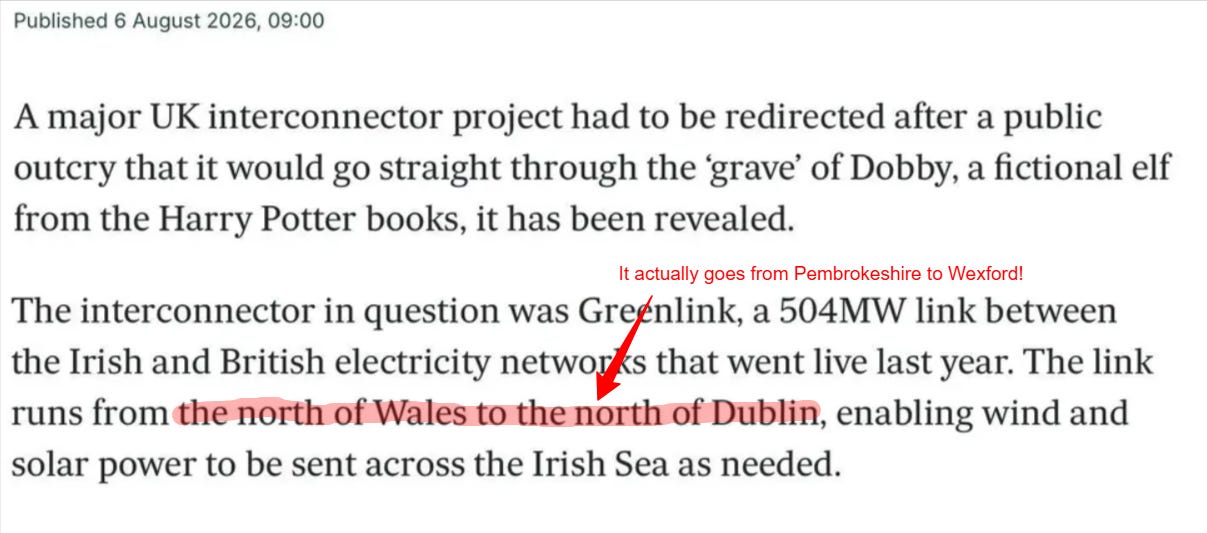
It was this quite shocking error which triggered my already finely calibrated spidey sense for an Infrastructure Guy talking rubbish on a podcast, using the rhetorical device I call a “chortle” to belittle an important planning point. When I started looking into it, though, it’s something quite a bit weirder.
As a chortle, it would have been a good example of the genre. Chris Curtis makes a good case here – anything which attracts a lot of children to a beach is probably worth diverting a cable away from, even if you think it’s a bit tacky. And Freshwater Beach is a really beautiful beach in a National Park, which is why it’s used as a film location so much. I originally thought that this might have been told as a self-deprecating joke, something like “check out the state of me – it took a bunch of Harry Potter fans to make me realise that I was about to dig up the best beach in South Wales!”
But as I say, it’s actually something weirder. One thing I should have realised earlier is that “a public outcry” isn’t actually a thing that can force you to move an infrastructure project. Planning permission or development consent[1] is given or withheld based on planning criteria, not because of a load of signatures on a petition.
And about that petition … there was a petition about the Greenlink connector, with 5000 signatures. But it didn’t mention “Dobby’s Grave” at all. There also doesn’t appear to have been any mention in the summary document on the consultation from Natural Resources Wales. Nor was it mentioned in the minutes of the planning committee, in the consultation responses submitted as part of the planning application or in contemporary press coverage. (And as you can see from the diagram on p15 of the planning committee document, the cable reaches land at the northern end of the beach, where its converter station is located. The pile of stones and socks is at the south end). It isn’t mentioned anywhere on Greenlink’s own website.
I can’t, actually, find any reference to the Greenlink project interacting with Harry Potter memorabilia which isn’t from 2026, and based on this podcast appearance. It clearly wasn’t a planning issue of significance greater than “trivial”, and looking at the site of the converter station at Neath Farm, I don’t think it’s very likely that anyone had ever planned to bring the cable onto the southern end of the beach.
And even if they had, they would never have done anything that disturbed the beach, because it’s an important beach in a national park. The plan was always to use horizontal drilling from out at sea to get the cable in, then use trench-and-cover further inland. (Natural Resources Wales did receive some comments in its consultation asking them to make sure that the drilling work didn’t coincide with the Welsh surfing championships).
So, this is weird. As far as I can tell, the company responsible for this cable did everything absolutely properly and professionally, and didn’t ever plan to do anything which would disturb the beach at all. There were reasonable concerns about the fact that it’s a beautiful beach and tourist asset which shouldn’t be messed around with, but these were all taken into account at a very early stage in the planning because they were so obvious. Harry Potter fans didn’t cause anything to be changed. The project got permission really quite quickly and has been in operation for a while now.
What was the guy talking about then? I think this is potentially a bit worrying.
It seems most likely to me that what we’ve got here is a pub anecdote that’s grown in the telling. I think they may have got a few phone calls if the Potter fandom discovered the petition. The petition might have got more signatures than it might otherwise have got from online Potter fans (remember, petitions don’t actually have a role in the planning process). And so, between 2018 and 2026, a story of “hehe, we got a bunch of calls we weren’t expecting” starts the fishermans’ tale process of “we had to move the whole cable because of Dobby the Elf!”.
The reason that this worries me is that this isn’t really what I’d call a “planning chortle”. It’s the creation of a chortle where there was no actual planning problem to exaggerate or mischaracterise. And I think this is potentially pointing to a real cultural problem in the infrastructure industry (and potentially the construction industry more widely) – the idea that public consultation is intrinsically frivolous and illegitimate, and that getting the permission of people affected by what you’re building is basically girly swot stuff that Real Men O’ Engineering shouldn’t have to be troubled by.
I haven’t mentioned names here because I don’t want to dunk on people and I can’t prove my suspicion above. (I’ve even cut off the names of the two journalists who didn’t bother looking at a map of Wales and Ireland; it isn’t really their fault that it went viral in the silly season). But I do feel it’s necessary to be a bit of a fun sponge and scold, even in August, over this sort of thing. The fact that someone who appears to have actually done a really good job on a green energy project, and to have managed the actual consultation and environmental impact process really well, nevertheless feels the need to scoff at it on a podcast later … I don’t think that’s a healthy sign, and it might have more to do with the “why can’t Britain build” problem than one might think.
So “they moved the cable for Dobby’s Grave!” story is indeed a symptom of our deep unseriousness as a country and our national malaise, just not in the way you might think.
[1] These are two different permissioning regimes; “planning permission” is given by a local authority, while “development consent” applies to Nationally Significant Infrastructure Projects (NSIPs) and is given by the Secretary of State. The Greenlink connector was, as far as I can tell, not designated as an NSIP despite its size and significance, but this isn’t uncommon; infrastructure developers often find it easier to deal with a single local authority so they don’t always apply to the NSIP process. None of this matters, but I had to learn all about it so I don’t see why you lot shouldn’t suffer.
Thanks for writing this, people were saying it isn't true and it seemed kind of fishy but not something I had time to look into.
It is important to only get mad about things that are real.
Well said.
I need to add though that it bothers me from the other angle. Lot of people out on the social media seem to think a "fiction-driven tourist site" isn't worthy of protection. But I can't help feel that if we proposed a nuclear plant in Brontë country, then fiction-driven tourism would suddenly be acceptable as an economic reason to alter a planning permission.